If You Don't Decide What Comes First, Your Position Will Decide It For You
Attention is a single track. A person can only value one thing at a time. While it may be possible to declare that you have multiple ‘important things,’ it is impossible to execute. In reality, you can only value things in the order you choose them moment by moment—in order of priority. ‘Everything is important’ is just another name for a schedule with no time allocated; in other words, it is a promise that won’t be kept.
If you think, ‘I want to value everything—both my work and my private life,’ I have one question for you: What did you spend the most time on last week? Your calendar has the answer. What is most important is reflected not in your words, but in how you use your time. If there is a discrepancy between your declaration and your records, the actual priority is the record.
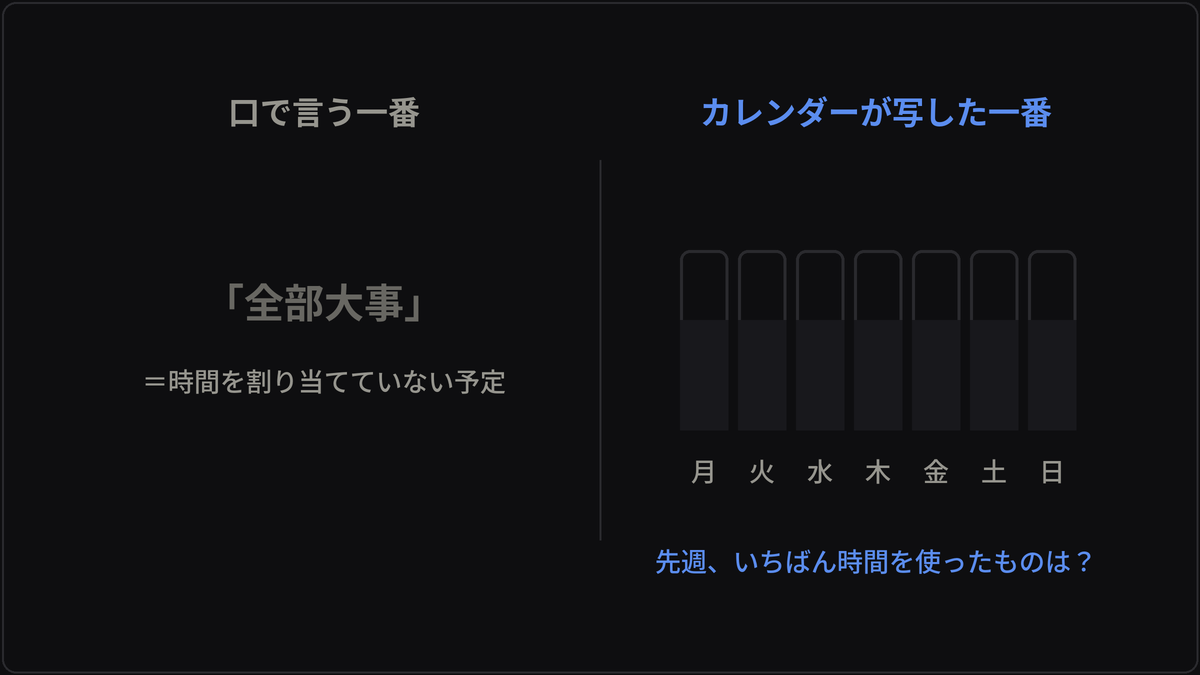
Therefore, the reality of making a choice is not ‘taking one thing and throwing the others away.’ It is about ranking them and drawing a floor (a minimum baseline) for everything except the top priority. You pursue only the number one with all your might, and for the rest, you simply ensure they don’t ‘fall through the floor.’ This protects everything better than trying to pursue everything.
Job postings dangle growth, stability, and work-life balance all at once. But a single position can generally only truly deliver on one of those. That is why you have no choice but to decide the ranking yourself before joining. For those who don’t decide their priorities, the position they take—the duty roster—will decide them automatically.
Saying you’ll ‘do your best at everything’ is not being sincere. It is a promise that won’t be kept. Being sincere means dividing things into the top priority and the bare minimum.