You can write a statement of purpose. You cannot fabricate what you actually stuck with.
Self-analysis fails not because the method is wrong, but because you are asking the wrong person. When you ask yourself “what do I want to do,” the answer that comes back is always contaminated—by parental expectations, societal norms, or an advertisement you just saw. Because desires are made of words, they can be overwritten indefinitely.
On the other hand, “what I stuck with” is a fact that has already occurred; it cannot be rewritten by anyone. The things you kept doing without being told. The things you realized you had stopped doing. Unlike a statement of purpose, a record of action cannot be exaggerated. Therefore, the observational data is not zero. In fact, only the data that cannot be exaggerated has already accumulated in your hands.
Divide a piece of paper into two columns. On the left, “things I said I wanted to do”; on the right, “things I realized I had stuck with.” When you write them out, the two sides will not match. The left column was created by words. The right column was created by time. Almost all of your choices up until now have likely been made based solely on the left column. The right column has not yet been used once.
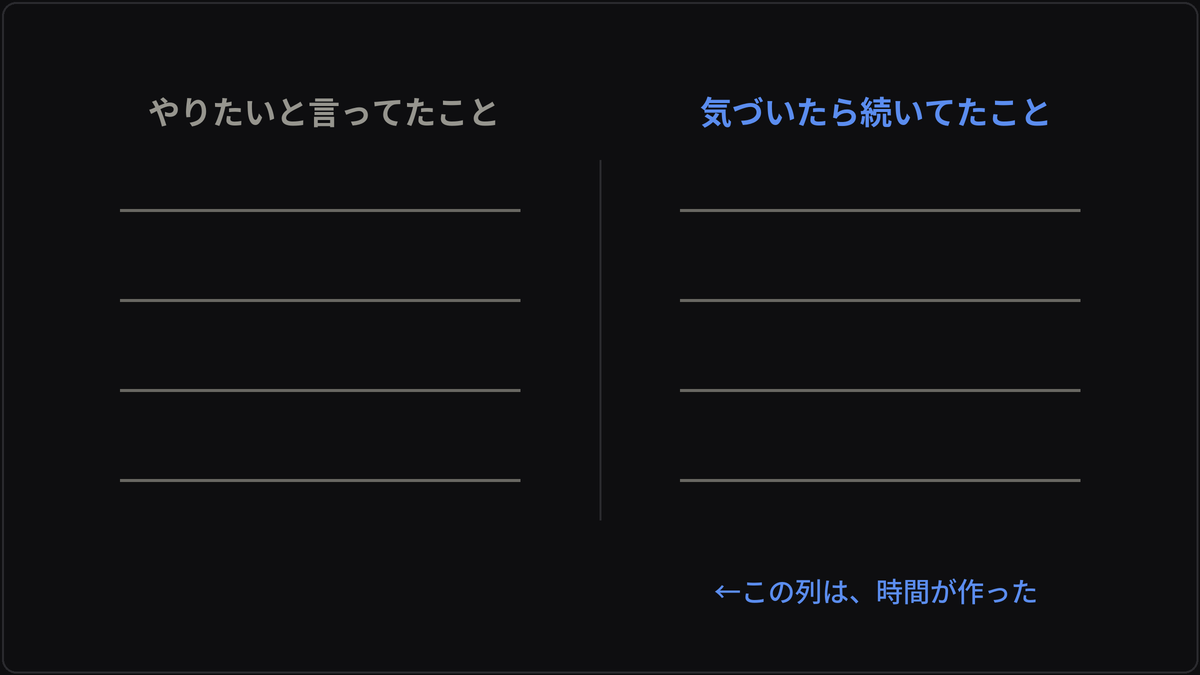
Look at a few of the items lined up in the right column and search for commonalities. What is reflected there is your true orientation—the version of yourself that doesn’t rely on declarations.
The way to know yourself is not through introspection. It is through the interpretation of your own records.